Not All Windshield Damage Is the Same
A small white dot and a long line running across your field of view are both windshield damage, but they are very different problems. The type of damage, where it sits on the glass, and how long it has been there all affect whether a technician can repair it in about 30 minutes or whether you are looking at a full replacement.
This guide covers every major auto glass damage type, explains how each one behaves, and gives you a clear picture of the repair-versus-replace decision. Think of it as a reference you can come back to any time you hear something hit your windshield.
One important note before we get into types: windshields are not the same glass as your side or rear windows. Your windshield is laminated glass, meaning two layers of glass are bonded to a flexible polyvinyl butyral (PVB) interlayer. That construction is why a struck windshield tends to crack or chip rather than shatter. Rear windows are tempered glass, and side windows are tempered when the vehicle is equipped with curtain side airbags - which behave differently under impact.
The Main Categories: Chips vs. Cracks
Before getting into specific types, it helps to understand the two broad categories.
A chip is localized damage at a single impact point. The glass has been struck hard enough to break or remove a small piece of the outer layer, but the damage has not yet spread outward in a significant way. Chips are generally smaller and, when caught early, are the most likely candidates for a repair rather than a replacement.
A crack is a line of separation in the glass that extends away from the original impact point, or that appeared on its own due to stress. Cracks can be short and stable or long and fast-moving depending on their type, their location, and conditions like temperature changes, road vibration, and moisture. The longer and more complex a crack becomes, the more likely it is to require a full windshield replacement.
Chip Types: What You Are Looking At
Chips come in several forms, and identifying which one you have gives you a better sense of urgency.
A bullseye chip looks like a dartboard: a cone-shaped impact point surrounded by a circular outer ring. These come from circular objects hitting the glass. A small bullseye can stay relatively stable, but if the inner or outer ring gets disrupted by heat, cold, or road vibration, it can spread quickly.
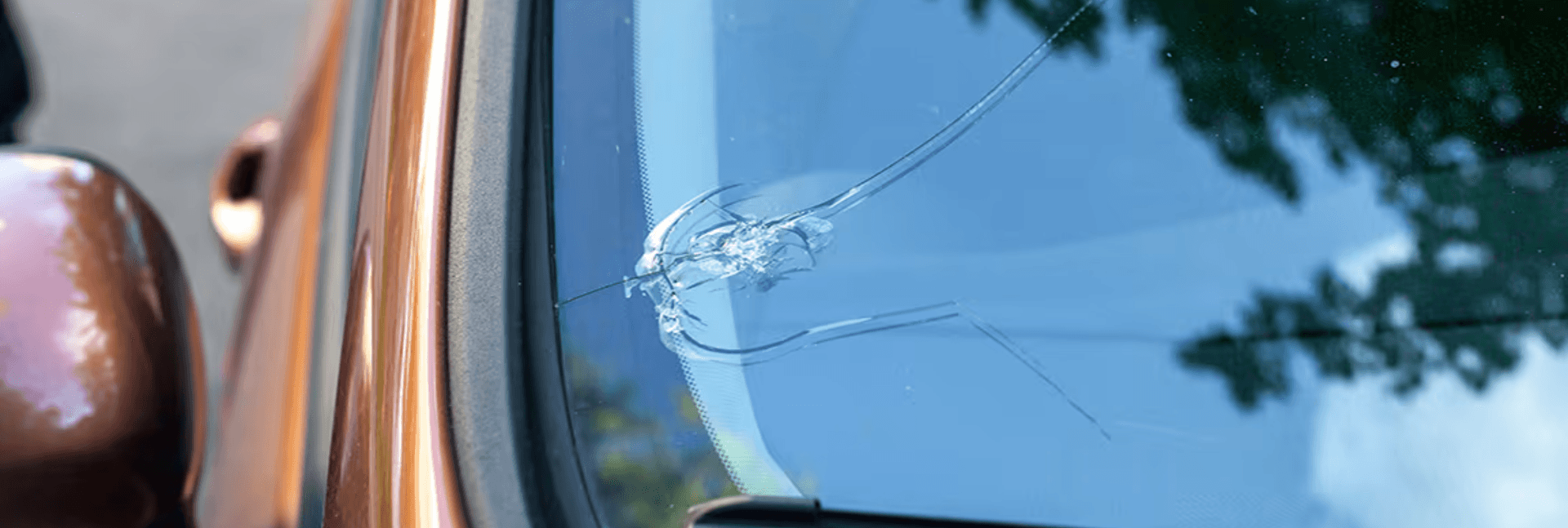
A star break has cracks radiating outward from the central impact point, like the points of a star. These come from sharp, high-velocity impacts and can extend further under added stress. They are still often repairable when caught early, but they tend to grow faster than a bullseye.
A combination break is exactly what it sounds like: a bullseye or partial bullseye at the center with star-pattern legs extending out from it. These are more complex because the damage covers more surface area.
A half-moon, sometimes called a partial bullseye, has a crescent shape at the impact site. It behaves similarly to a full bullseye.
Finally, a pit is a tiny surface nick with no surrounding pattern. Pits are usually the least urgent chip type, though they can grow if ignored and they do affect optical clarity over time.
Crack Types: How Lines in Glass Behave
Cracks are more varied than chips, and their location on the windshield matters as much as their shape.
A stress crack appears without any direct impact. It typically starts at the edge of the windshield and moves toward the center. Sudden temperature changes are the most common trigger: a cold windshield blasted with hot air, or a hot windshield hit by an air-conditioned interior. Poor installation that creates uneven pressure in the glass can also cause them. Because stress cracks start at the perimeter, they fall into the edge crack category, which we cover next.
An edge crack originates at or very near the windshield's border, usually within two inches of the frame. An edge crack starts at, or very close to, the windshield’s outer border. The edge of the windshield is more vulnerable because it is part of the bonded structure and any crack that reaches the edge can affect the integrity of the glass. Edge cracks also tend to spread quickly, especially when the vehicle is exposed to road vibration, potholes, body movement, or temperature swings. For that reason, edge cracks are often more likely to require replacement than repair.
A floating crack appears in the middle of the windshield, away from any edge. These often start from an impact and grow outward. Their behavior depends heavily on size and location: a short floating crack in the passenger corner is a very different situation from one that crosses the driver's line of sight.
A long crack is generally defined as one that has grown beyond a few inches. Longer cracks are more susceptible to spreading because they are more affected by road vibration, air pressure from driving, and moisture that can work its way into the separation and push the glass further apart in temperature changes. As a general threshold, damage larger than a dollar bill or cracks longer than three inches often point toward replacement rather than repair, though a technician needs to inspect each situation directly.
Why Location on the Glass Changes Everything
Two cracks of identical size can lead to completely different outcomes depending on where they sit on the windshield.
Damage in the driver's direct line of sight is the most urgent category. Even a repaired chip leaves behind a small blemish at the impact site, and any optical distortion in that zone is a safety problem. A crack that crosses the driver's primary viewing area almost always requires replacement, not repair. This is also the damage that can lead to failing a vehicle inspection in many states, though inspection rules vary by state.
Damage near the edge of the windshield, as noted above, is more likely to spread because it is closer to the bonding area or the glass and is more susceptible to stress and vibration. Even a chip closer to the perimeter warrants faster attention than the same chip in the center.
Damage near ADAS camera mounting points is a separate concern. Many vehicles built in the last several years have cameras and sensors mounted to the windshield that power systems like lane departure warning, forward collision alerts, and adaptive cruise control. When a windshield is replaced, any windshield-mounted ADAS camera systems will require recalibration to function properly. If a chip or crack is located near the camera’s viewing area, the technician should consider that during the repair versus replacement assessment. Even if the chip appears repairable, repairing damage within the camera’s field of view may still affect system visibility and will require calibration afterward.
The Repair vs. Replace Decision: A Practical Framework
This is the question every driver wants answered: can this windshield be fixed, or do I need a new windshield?
As a general starting point, a chip or crack is more likely to be repairable when: it is smaller than a quarter, the crack has not started to branch or spider outward, and there are no more than three chips total. That is general guidance, not a guarantee. A technician has to look at the actual damage before making that call.
Windshield replacement becomes the likely recommendation when: damage is larger than a quarter, there are more than 3 chips, a crack has reached the driver's line of sight, damage sits at the edge of the windshield and has already begun to run, or the structural integrity of the glass has been compromised to the point where repair resin cannot restore it.
The windshield repair process works by cleaning the damaged area and injecting clear resin, which is then cured with UV light. This restores structural integrity and can be completed in as little as 30 minutes. It is cost-effective and quick. That said, a repaired chip will still have a small visible blemish at the impact site. That is normal and expected. In some cases, damage can still spread even after a repair.
Replacement removes the damaged windshield and installs a new one. AGN uses OEE (Original Equipment Equivalent ) glass, which is approved by the insurance industry. Replacement costs more and takes longer than a repair, but it provides a clear, undamaged windshield and restores the glass to its proper role in the vehicle’s safety structure.
One thing that does not improve with time is windshield damage. Temperature changes cause glass to expand and contract, which can place added stress on existing chips or cracks. Road vibration can also work its way into weak points in the glass, causing the damage to spread. Moisture may enter the damaged area and become trapped, which can make the problem worse in both hot and cold weather. A small chip that may be repairable today can turn into a full windshield replacement if it is left alone for weeks.
Side Windows and Rear Glass: What Is Different
Most of the discussion above focuses on windshields because that is where the majority of damage happens and where the structural and safety stakes are highest. But side and rear windshields have their own considerations.
The majority of side windows and all and rear windows are made from tempered glass rather than laminated glass. Tempered glass is designed to break into small, relatively dull pieces rather than sharp shards. Because of that construction, it generally cannot be repaired the way a windshield chip can. When a side window is damaged, replacement is typically the only option, and AGN handles side window and rear windshield replacement. Customers can schedule mobile service so a technician comes to them, or bring the vehicle to a shop location.
The urgency for side window damage is also practical: a broken or cracked side window leaves the vehicle open to the elements and is a security issue. Getting it handled quickly matters.
When to Stop Driving and Get It Checked Today
Most chips and small cracks do not require you to pull off the road immediately. But a few situations do.
Do not drive if the crack runs through the area you look through to see the road ahead. A distorted or blocked view is dangerous, full stop. Do not drive if the glass appears to be bulging, separating from the frame, or if the windshield feels structurally unstable.
For everything else, sooner is better but same-day is not always mandatory. What matters is getting an expert to look at it before temperature changes, a pothole, or a car wash turns a repairable chip into a crack that runs across the entire windshield.
AGN inspects damage for free and gives an honest repair-versus-replace opinion. Same-day and next-day appointments are available, and most AGN locations also offer no-fee mobile service so a technician can come to you. Call 1-888-4-FIX-GLASS (1-888-434-9452) or schedule online to get started.
A Note on Optical Quality and Structural Integrity
Two terms that come up in auto glass discussions are worth understanding as a driver.
Optical quality refers to how clearly and accurately you see through the glass. Small pits, blemishes, repaired chips, or older glass with UV degradation can all reduce optical quality over time. The windshield is not just a barrier; it is something you look through constantly while driving. Any distortion, hazing, or refraction in your line of sight is a safety concern, not just an aesthetic one.
Structural integrity refers to the windshield's role in keeping your vehicle's frame rigid. This surprises many drivers, but the windshield is a structural component of the car. It supports the roof and contributes to how the vehicle holds up in a collision, particularly a rollover. A cracked windshield leaves the frame weaker than an intact one, which is why driving on a significantly damaged windshield carries real risk beyond just visibility.
Both factors, optical quality and structural integrity, are reasons why a professional assessment matters more than a quick visual judgment from the driver's seat. What looks like a minor crack from outside the car may cross a critical zone or have spread in a way that is not immediately obvious.